Best eSIM for Cruise Travel: What to Choose
Introduction
The moment your ship leaves port, your usual mobile setup can become expensive very quickly. Finding the best eSIM for cruise travel is less about chasing the cheapest data plan and more about understanding where an eSIM actually works, where it does not, and how it fits around cruise ship Wi-Fi and roaming at sea.
That distinction matters because cruise travel is different from a standard city break. You may spend part of your holiday in the UK, then fly to another country, board in a third, visit several ports, and spend long stretches offshore. A good eSIM can make that far simpler, but only if you choose one with the right coverage and use it in the right way.
What the best eSIM for cruise travel really needs to do
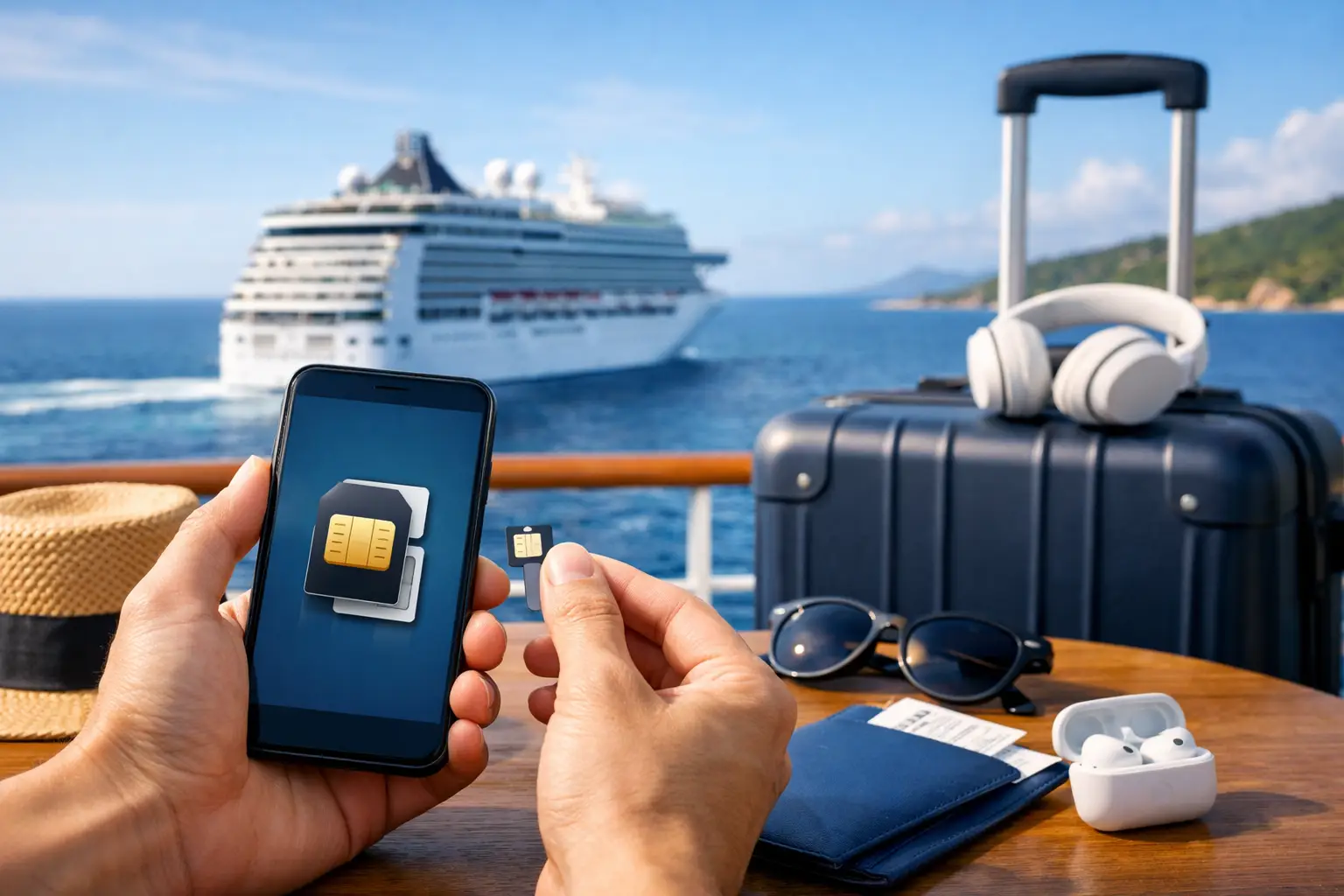
For most cruise guests, an eSIM is there to cover the land-based parts of the journey. That means your airport transfers, hotel stay, embarkation day, port calls and the journey home. In those moments, having mobile data for maps, taxi apps, messaging and emails is genuinely useful.
Where travellers get caught out is assuming an eSIM will continue working normally once the ship is out at sea. In most cases, it will not. Your phone needs access to a terrestrial mobile network, and once you are offshore, that signal disappears. At that point, the ship usually relies on satellite internet, and mobile use may switch to maritime roaming, which can be very costly.
So the best option is usually not an eSIM marketed vaguely as “global”, but one that gives you strong coverage in the countries on your itinerary and pairs sensibly with your cruise line’s onboard Wi-Fi package.
Can you use an eSIM on a cruise?
Yes, but only in specific parts of the trip.
An eSIM works well before embarkation, in port, and often when the ship is close enough to land to pick up a local network. It is much less reliable, and often completely unusable, during sea days or overnight crossings when the ship is well offshore.
That is why cruise travellers should think of eSIMs as one part of a wider connectivity plan. Your eSIM is for days ashore and travel logistics. Your ship’s Wi-Fi, if you choose to buy it, is for onboard use. Trying to make one product cover both perfectly is where disappointment usually starts.
The main eSIM options for cruise holidays
Most cruise travellers will end up choosing between three broad types of eSIM.
Regional eSIMs
These are often the most sensible choice for Mediterranean, Baltic and European river cruises. If your sailing includes Spain, France, Italy and Greece, for example, a Europe eSIM is often better value than buying separate country plans. It also saves the hassle of switching products as you move around.
For UK travellers, this tends to be the sweet spot. You get one plan that covers the pre-cruise hotel, embarkation port and most shore days, which is exactly when you need data most.
Global eSIMs
A global eSIM can work well for longer itineraries, especially if your holiday includes flights, stopovers or ports in more than one region. The trade-off is that global plans can be more expensive per gigabyte, and speeds may not always be as strong as a region-specific option.
They are useful for repositioning cruises or more complex fly-cruise arrangements, but for a straightforward week in the Med, they are not always the best-value choice.
Single-country eSIMs
These can be excellent if your cruise begins and ends in one country, or if you are adding a longer land stay before or after the cruise. If you are spending four nights in Barcelona before embarkation, for instance, a Spain-only eSIM may suit you better than a broader plan.
The downside is obvious on multi-country itineraries. Once you leave that country, you may need another plan or lose coverage.
What to check before you buy
Choosing the best eSIM for cruise travel comes down to a few practical details.
First, confirm your phone supports eSIM. Most newer iPhones, Samsung Galaxy models and Google Pixel phones do, but not every handset does. It is worth checking before purchase rather than discovering the limitation at the airport.
Second, look closely at coverage countries rather than marketing headlines. “Europe” may not always include every port on your itinerary, and some plans exclude places travellers assume are covered. If your cruise includes Turkey, Montenegro or Norway, check each destination individually.
Third, consider data allowance in the context of cruise travel. You may not need huge amounts if you are mainly using your eSIM for messages, maps, online check-ins and occasional browsing in port. On the other hand, if you plan to stream video from the beach or tether a laptop in every destination, a very small plan may become frustrating.
Finally, check activation rules. Some eSIMs activate the moment you install them, while others begin only when they connect to a supported network. For cruise guests who like to prepare in advance, that difference matters.
eSIM vs cruise ship Wi-Fi
This is where expectations need to be realistic. An eSIM is usually the better tool for use ashore. Cruise ship Wi-Fi is the better tool for use onboard.
If your main priority is messaging family, checking excursion details, using Google Maps in port and keeping an eye on travel documents, an eSIM can be extremely cost-effective. If your priority is being reachable while crossing the Atlantic or posting on social media from your cabin every evening, you will probably need the ship’s internet package as well.
Many seasoned cruisers use both. They rely on onboard Wi-Fi during sea days and switch to their eSIM when they are in port. That approach often gives the best balance between convenience and cost.
When an eSIM may not be enough
There are a few situations where an eSIM on its own is not the answer.
On transatlantic, world cruise or expedition-style itineraries with many sea days, the value of an eSIM drops because so much of the trip takes place outside normal mobile coverage. In those cases, onboard internet becomes more central.
It can also be less useful for travellers who are not comfortable changing mobile settings. Most eSIM setup is straightforward, but you do need to be happy installing a plan, selecting data lines and turning roaming settings on or off correctly.
There is also the question of calls and texts. Many data-only eSIMs do not come with a standard phone number. That is fine for WhatsApp, email and app-based communication, but it may not suit everyone.
A practical way to choose the right eSIM
If you want a simple rule of thumb, match the eSIM to your itinerary rather than to the cruise line.
For a Mediterranean or Baltic sailing, choose a regional Europe eSIM with enough data for your port days and travel days. For a Caribbean cruise, look at a plan that covers your embarkation country and the islands you are actually visiting, while keeping in mind that some island coverage can be patchy or priced differently. For a longer itinerary spanning several regions, a global eSIM may justify the extra cost.
It also helps to think about your habits. Light users who mainly need directions, restaurant searches and messages can manage comfortably on a modest data plan. Heavy users who upload photos, make video calls and stream content should size up accordingly.
Common mistakes cruise travellers make
One of the biggest mistakes is leaving mobile data on and allowing the phone to connect automatically to a maritime network. That can trigger very high charges if your primary SIM starts roaming at sea. If you are using an eSIM for port days, it is wise to understand exactly which line is active and what your phone is allowed to connect to.
Another common error is buying too late. Installing and testing your eSIM before travel is far better than trying to sort it out in a busy terminal or on embarkation day.
Travellers also sometimes overestimate how much they need. A cruise is not usually a holiday where you spend hours on mobile data every day. Between time onboard, organised excursions and meals ashore, many people use less than expected.
So what is the best eSIM for cruise travel?
For most UK cruise travellers, the best eSIM for cruise travel is usually a regional or multi-country plan that covers your embarkation point, your ports of call and any pre- or post-cruise stay. It should be easy to activate, clear about which countries are included, and sized sensibly for how you actually use your phone.
What it probably is not is a magic answer for internet access in the middle of the sea. That is the key point to keep in mind. The smartest setup is often an eSIM for travel days and port days, plus onboard Wi-Fi only if you know you will want connection during sea days.
The Essential Cruise Shop approach is always to make the small practical decisions easier, and this is one of them. If you choose with your itinerary in mind rather than the marketing label, you are far more likely to stay connected without paying for features you will not really use.
A little preparation here can save a surprising amount of stress later, especially when you are trying to find your hotel, message family from port, or sort out a transfer on embarkation morning.
Frequently Asked Questions
Disclaimer
The Essential Cruise Shop Blog provides this guide for informational purposes and is not a travel agency. The information contained in this guide is for general guidance only. While we do our best to ensure the information is up-to-date and correct, we make no representations or warranties of any kind about its completeness or accuracy.
Cruise line policies, itineraries, and loyalty programs are subject to change without notice. We strongly recommend that you verify all details directly with your cruise line or a certified travel agent before making any bookings or financial commitments.
We cannot be held liable for any financial loss due to the reader’s failure to follow the above advice.
Affiliate Disclosure
Many of the links are affiliate links, The Essential Cruise Shop Blog may receive a commission from qualifying clicks, orders or bookings. This income helps support our efforts to provide and improve our site and turn it into a one stop resource for travellers with a bias towards cruising.