How to Choose a Cruise Approved Power Bank
Introduction
A flat phone while you are waiting for a transfer, finding your way around a port, or trying to show a boarding pass is more than a minor inconvenience. A cruise approved power bank can be a very useful part of your holiday kit, but the phrase needs a little unpacking. There is no single universal cruise approval label, and the right choice must satisfy both your cruise line’s safety rules and, if you are flying, your airline’s battery regulations.
What does cruise approved power bank really mean?
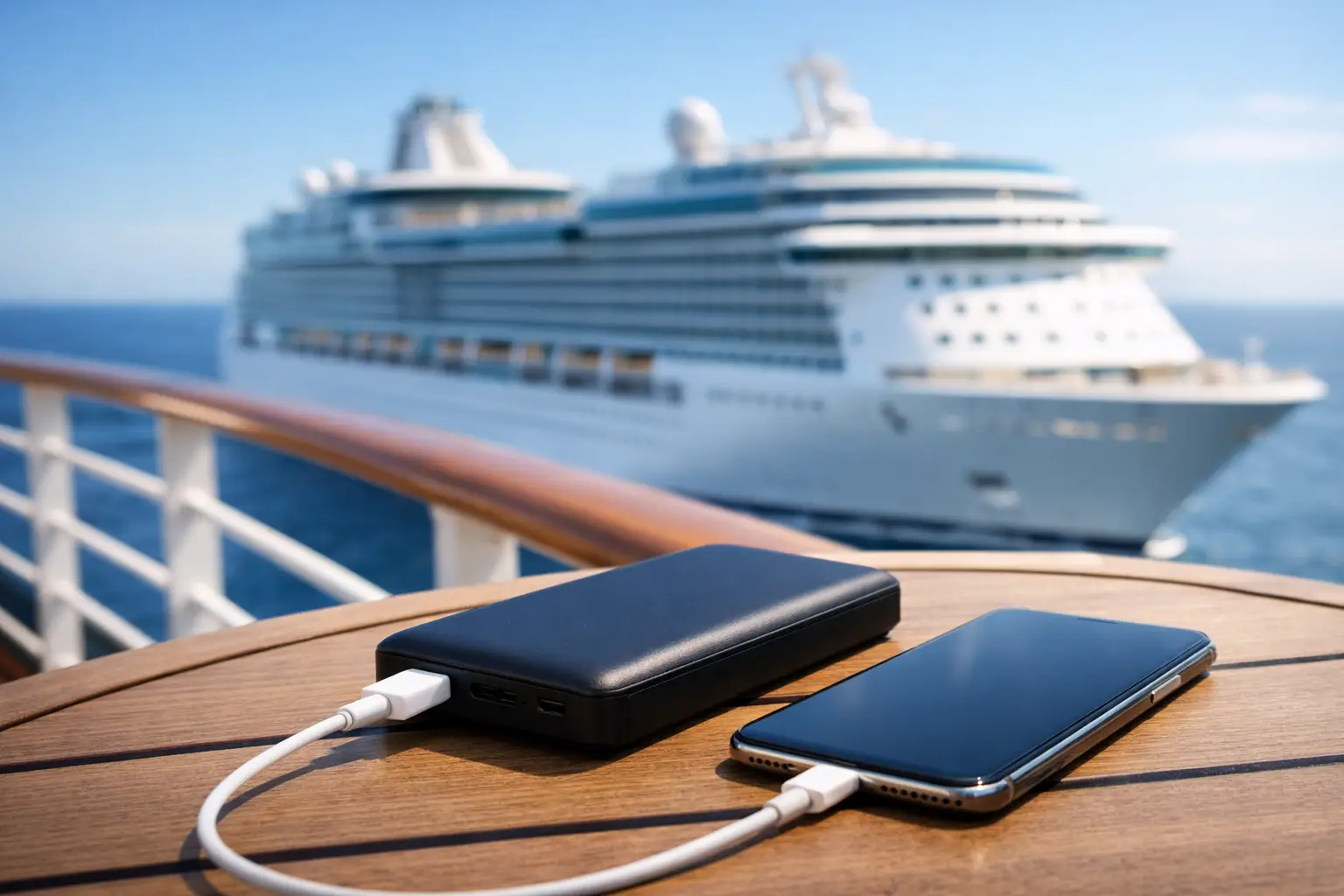
In practical terms, a cruise approved power bank is a portable charger that is permitted by your cruise line and safe to carry under airline lithium-battery rules. Most mainstream cruise lines allow personal power banks, but their policies can change and individual ships may apply safety checks at embarkation. Always read the current prohibited-items list for your particular line shortly before travelling.
The restrictions are not designed to make packing difficult. Lithium-ion batteries can pose a fire risk if they are damaged, poorly made or incorrectly used. Cruise ships take battery safety seriously because a small incident needs to be contained quickly at sea.
A standard, good-quality power bank for charging a phone, tablet, e-reader or camera is usually a sensible choice. Problems are more likely to arise with oversized battery packs, unbranded products of uncertain quality, damaged units, or items intended to power high-wattage appliances. A portable charger is not a substitute for a travel kettle, heated styling tool or cabin extension lead, all of which may be restricted by the cruise line.
Check airline rules before cruise line rules
For fly-cruises, the airline rule is often the limiting factor. Spare lithium batteries and power banks must normally travel in your hand luggage, not in a checked suitcase. If a battery overheats in the cabin, crew can respond; in the aircraft hold, that is far more difficult.
Airlines generally permit power banks up to 100 watt-hours (Wh) without prior approval. Batteries between 100Wh and 160Wh may require airline permission, while larger units are commonly prohibited for passengers. Policies do vary, particularly between airlines and on connecting flights, so confirm the allowance directly with every carrier on your journey.
Do not rely on milliamp-hours alone. Airlines use watt-hours, and a reputable battery should show its Wh rating clearly on the casing. As a useful guide, a 10,000mAh power bank is usually about 37Wh, a 20,000mAh model is around 74Wh, and a 26,800mAh model is close to 99Wh. The figure can vary slightly according to the battery’s voltage, which is why the printed Wh marking matters.
If the label has worn off or the capacity cannot be identified, security staff may be unable to verify it. Choose a clearly marked product and keep it easy to reach in your cabin bag for airport screening.
Choosing the right cruise approved power bank
For most cruise holidays, a compact 10,000mAh to 20,000mAh model offers the best balance of capacity, weight and convenience. A 10,000mAh unit will generally give a modern smartphone around one to two full charges, depending on the phone and how efficiently it charges. A 20,000mAh model is more useful for a long day ashore, a couple sharing one charger, or a voyage with several sea days and heavy use of phones or tablets.
Capacity is not the only consideration. Look for these practical features when comparing options:
- A clearly printed capacity in both mAh and Wh, ideally below 100Wh for straightforward air travel.
- Recognised safety certification and built-in protection against overheating, overcharging and short circuits.
- USB-C input and output, particularly if your phone or tablet already uses USB-C.
- Two charging ports if you regularly travel as a couple, although shared output may charge devices more slowly.
- A simple battery-level indicator, so you know whether to recharge before going ashore.
Fast charging is convenient, but it is worth checking that your existing cable and device can use it. There is little benefit in paying extra for very high output if your phone only accepts a lower charging rate. Equally, a larger power bank may look reassuring, but it adds noticeable weight to a day bag and takes longer to recharge in the cabin.
For many UK travellers, a well-made 10,000mAh USB-C power bank is the uncomplicated option. If you use your phone for photographs, maps, shore-excursion tickets and keeping in touch with family, stepping up to 20,000mAh may be worthwhile. It depends on how independently you explore and whether your travelling companion will be sharing it.
Safe use on board and ashore
Buy the power bank well before departure and test it at home with the cables you plan to take. This avoids discovering at the airport that a cable only charges in one direction, or that the battery itself takes all night to recharge.
Once on board, charge the unit on a hard, clear surface where you can see it. Avoid leaving it charging unattended, under pillows, on bedding or in direct sunshine on a balcony. Disconnect it once it is fully charged, and stop using it immediately if it becomes unusually hot, swells, leaks, smells odd or has a cracked case.
The same care applies ashore. Keep it in a pouch or a separate pocket of your day bag rather than loose with keys, coins or damp swimwear. A short cable is often easier to manage while walking, but do not use your phone and power bank in a way that leaves either item exposed to rain, sea spray or a crowded pavement.
It is also sensible to charge your phone before leaving the ship. A power bank is best treated as reserve capacity, not the only plan. That approach is particularly helpful on excursion days when you may rely on your phone for the ship’s contact details, your return time, maps, tickets or a taxi payment.
Packing and cabin considerations
Put the power bank in your hand luggage for the flight and keep it with you through the airport. If you are joining a cruise from the UK without flying, carry it in your embarkation bag rather than burying it in a large case. You may want it charged and ready during the journey to the port.
Pack only the cables you genuinely need. A USB-C cable, a Lightning cable where relevant, and a compact multi-port wall charger can be neater than several separate plugs. Before buying any cabin charging accessory, check your cruise line’s current rules on extension leads, multi-socket adaptors and USB charging hubs. Cruise lines can be stricter about devices that alter or multiply the cabin’s electrical supply than they are about a simple power bank.
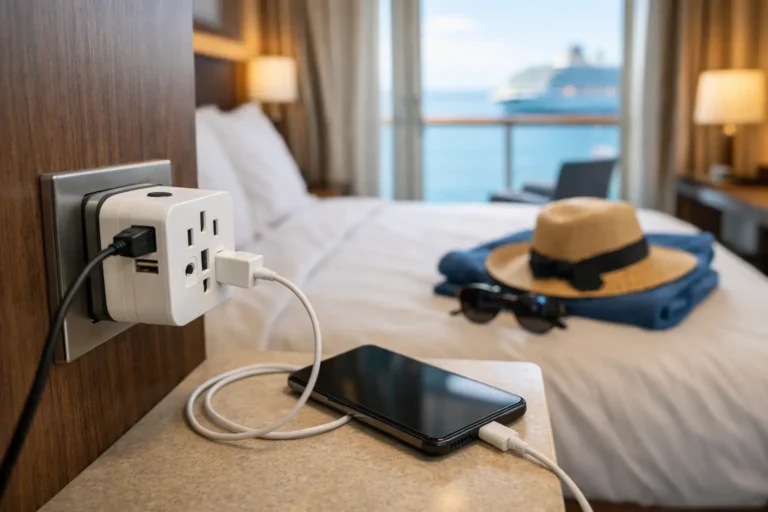
Cabin sockets differ by ship, cruise line and refurbishment date. Some ships offer UK sockets, some European or US sockets, and some have USB ports by the bed. A power bank gives you flexibility, but it does not remove the need for the correct plug adaptor for your own charger.
A dependable power bank is a small item that can make the travel days around your cruise feel considerably calmer. Choose one that is clearly labelled, sensibly sized and easy to use, then keep it charged for the moments when your holiday runs slightly away from the nearest plug socket.
Frequently Asked Questions
Disclaimer
The Essential Cruise Shop Blog provides this guide for informational purposes and is not a travel agency. The information contained in this guide is for general guidance only. While we do our best to ensure the information is up-to-date and correct, we make no representations or warranties of any kind about its completeness or accuracy.
Cruise line policies, itineraries, and loyalty programs are subject to change without notice. We strongly recommend that you verify all details directly with your cruise line or a certified travel agent before making any bookings or financial commitments.
We cannot be held liable for any financial loss due to the reader’s failure to follow the above advice.
Affiliate Disclosure
Many of the links are affiliate links, The Essential Cruise Shop Blog may receive a commission from qualifying clicks, orders or bookings. This income helps support our efforts to provide and improve our site and turn it into a one stop resource for travellers with a bias towards cruising.