eSIM vs Roaming for Cruises: Which Is Better?
Your phone can be one of the most useful items in your cruise luggage – until it connects to a maritime network without you realising. When weighing up eSIM vs roaming for cruises, the key is separating the time you spend in port from the time you spend at sea. They are very different mobile situations, and the cheapest option for one may be unsuitable for the other.
For most UK cruise guests, an eSIM is the more economical choice for using maps, messages and travel apps ashore. Roaming can be simpler, particularly when your UK provider includes the countries on your itinerary. Neither option, however, is usually the answer for reliable mobile data while the ship is sailing between ports.
First, understand the three places your phone can connect
A cruise holiday can involve your normal UK network before departure, local land-based networks in each destination, and the ship’s onboard maritime mobile network. The last of these causes most unexpected bills.
At sea, a ship may provide a cellular service through a satellite connection. Your phone can show signal and automatically join it, but this is not the same as ordinary overseas roaming. It is often charged separately, is rarely included in standard daily roaming passes, and can be expensive for even modest data use.
In port, your phone may instead connect to a local network in Spain, Norway, Greece, the Caribbean or wherever your itinerary takes you. This is where an eSIM or your provider’s roaming allowance can be genuinely useful. Close to land, however, your handset can occasionally still select the maritime network, especially if the ship remains just offshore. Checking the network name before using data is a worthwhile habit.
eSIM vs roaming for cruises: the practical difference
Roaming means using your existing UK SIM and mobile number abroad. Depending on your provider and tariff, this may be included, charged as a daily pass, or billed by the minute, text and megabyte. It is convenient because there is nothing new to install and calls to your usual number will still arrive as normal.
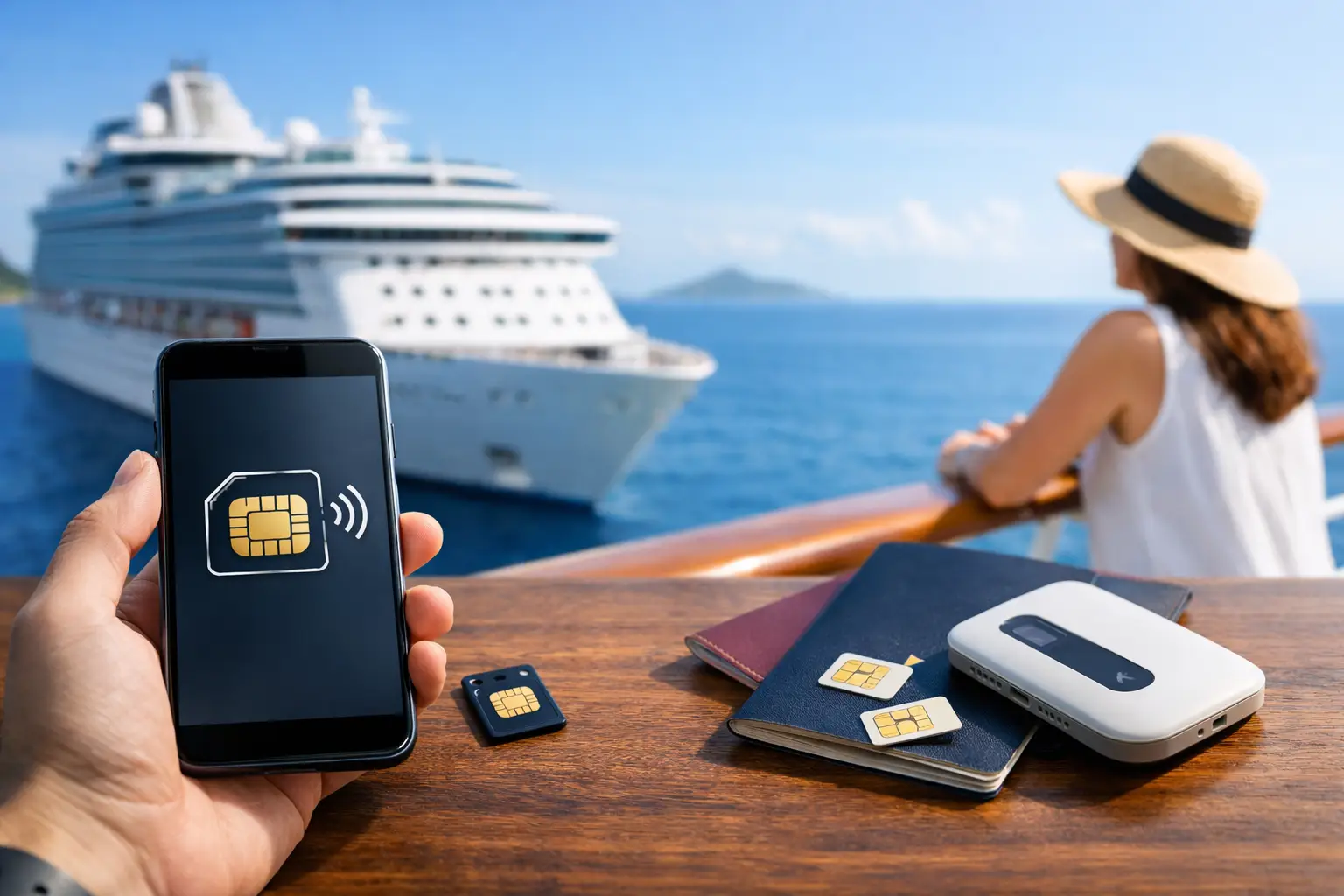
An eSIM is a digital SIM profile added to an eSIM-compatible phone. You purchase a data plan for a country, region or group of destinations, then activate it when you need it. Most travel eSIMs are data-only, so you normally use WhatsApp, FaceTime, iMessage or another internet-based service for messages and calls. Your usual physical SIM can usually remain in the phone for texts, calls and security codes, provided you manage its data settings carefully.
The better choice depends less on the cruise line and more on your itinerary, handset, home mobile plan and expected usage.
When roaming is the sensible option
Roaming can be excellent value if your tariff includes your ports or offers a reasonably priced daily pass. A Mediterranean cruise with calls at EU destinations may be straightforward, although UK mobile providers now have very different policies following Brexit. Never assume that EU roaming is included simply because it was on a previous contract.
It also suits guests who want to keep one number active without changing phone settings, who expect to make ordinary calls, or who only need occasional data. If you plan to use your phone mainly for a quick message to family, checking a restaurant booking or ordering a taxi after a shore excursion, a daily roaming pass may be easier than buying a separate eSIM.
Roaming becomes less attractive on itineraries with several countries outside your allowance. It can also be poor value if you pay a daily fee each time your phone uses a small amount of data. Check whether the pass starts automatically, how long it lasts, the data limit, and whether cruise-ship networks are excluded.
When an eSIM is the better fit
An eSIM tends to suit guests visiting several ports who want affordable data without relying on patchy public Wi-Fi. A regional plan can cover a whole Mediterranean, Caribbean or Northern Europe itinerary, although the country list must be checked carefully. Not every regional eSIM includes every island or territory, and coverage on a transatlantic or world cruise may need more than one plan.
It is particularly useful for independent port days. You can use maps away from the ship, look up public transport, contact a tour operator, check attraction opening times and send messages without worrying about consuming expensive ship Wi-Fi. It can also be a good choice for a pre-cruise hotel stay and the journey between airport, hotel and terminal.
The trade-off is a little preparation. Your phone must be unlocked and eSIM-compatible, and you need to install the plan correctly before travel or while connected to Wi-Fi. Data roaming must be enabled for the travel eSIM, but disabled for your UK SIM if you do not want it using paid data abroad. It is wise to take a screenshot of the activation instructions and keep the provider’s details available offline.
The option many guests overlook: cruise Wi-Fi
For internet access on the ship itself, the cruise line’s Wi-Fi package is generally the most reliable and predictable option. It is not mobile roaming, and it does not depend on your phone finding a land-based signal. Packages vary widely: some are intended for messaging and light browsing, while others support social media, video calls or multiple devices.
Cruise Wi-Fi is not automatically essential. On a port-intensive itinerary, you may be ashore most days and only want an eSIM for maps and messages. On a sea-day-heavy voyage, a Wi-Fi package can make more sense, especially if you need regular contact with family or have work commitments.
Before buying, consider how many people and devices need access. Some lines sell Wi-Fi per device, so a couple may need to log one person out before another can connect. Others allow multiple devices under one package. Also check whether video calling, streaming and hotspot use are restricted. Onboard connectivity has improved considerably, but performance can still vary with the ship’s location and the number of guests online.
A sensible setup for most cruise holidays
Many experienced cruisers use a combination rather than choosing one service for the entire trip. They switch off mobile data and data roaming on their UK SIM before the ship sails, use onboard Wi-Fi when they need internet at sea, and use an eSIM or approved roaming pass once ashore.
This approach also protects against background data. App updates, photo backups, email downloads and social media refreshes can quietly use data. Before leaving home, disable automatic updates over mobile data, pause cloud photo uploads, download maps and entertainment, and make sure your phone’s data warning is set to a level you would notice.
If you rely on your UK number for banking verification or family contact, leave the SIM enabled for calls and texts but turn off its data roaming. Be aware that receiving texts is often free, but charges and policies differ by provider. If you answer a call while abroad, you may incur costs even when you have an eSIM providing data.
Ocean cruises and river cruises are not the same
On an ocean cruise, do not plan on an eSIM or standard roaming to work throughout the voyage. Once the ship is beyond reach of land, neither has a normal local network to use. Your practical choices are onboard Wi-Fi, a carefully priced maritime roaming service, or a deliberate digital break.
River cruising is different. Ships usually travel close to land and stop frequently, so local mobile coverage can be available for much of the journey. An eSIM or roaming allowance may therefore deliver more consistent value, though coverage can still drop in rural stretches, locks and valleys. River cruise guests should still check which countries their route passes through, not just the embarkation and disembarkation ports.
Check these details before you leave
The right decision becomes much clearer when you review a few specifics before paying for anything:
- Your UK provider’s roaming countries, daily charge, data allowance and maritime-network policy.
- Whether your phone is unlocked and supports eSIM, particularly if it is an older model.
- Every country and territory on your itinerary, including pre-cruise and post-cruise stays.
- The cruise line’s Wi-Fi prices, device limits and package restrictions.
- How much data you are likely to use for maps, messaging, browsing, video calls and photo sharing.
It is also worth checking whether your cruise line’s app works on its free onboard network. Many lines allow access to daily programmes, dining reservations and onboard messaging functions without purchasing a full Wi-Fi package, although features differ by ship.
So, which should you choose?
Choose roaming if your provider covers your itinerary at a fair price and you value the simplicity of keeping everything on one number. Choose an eSIM if you want lower-cost, flexible data in port, particularly across several destinations or on independent shore days. Add cruise Wi-Fi if staying connected at sea matters to you.
The small piece of preparation that pays off most is switching off your UK mobile data before sail-away. With that done, you can decide when to connect rather than discovering later that your phone made the decision for you.