How to Organise Cruise Documents Without Stress
Introduction
The last thing you want at the terminal is to be searching through emails while the check-in queue moves around you. Knowing how to organise cruise documents properly means you can begin your holiday calmly, whether you are sailing from Southampton, flying to the Mediterranean, or joining a river cruise in Europe.
A cruise involves more moving parts than a typical hotel break. Alongside your cruise booking, there may be flights, a hotel stay, private transfers, travel insurance, visas and shore excursion confirmations. The most reliable approach is to keep the essential documents together, with digital backups that remain available if your signal disappears.
Start with the documents you must have
Your passport is the priority. Check its expiry date as soon as you book, rather than assuming it will be valid because your holiday is only a week or two long. Many countries require a passport to remain valid for several months after arrival, and cruise lines may apply their own requirements depending on the itinerary. Names on your cruise reservation, flights and passport should match exactly, including middle names where they appear.
Your cruise line will usually issue boarding information through its app, online check-in area or by email. Complete online check-in as soon as it opens. This is where you may need to provide passport details, a security photograph, emergency contact information and payment card details for onboard spending. Once complete, save or print the boarding pass and any luggage labels provided.
Keep these core items in one clearly labelled travel wallet or slim document organiser:
- Passports and any required visas or travel authorisations
- Cruise boarding passes, booking confirmation and luggage labels
- Flight, rail, hotel and transfer confirmations
- Travel insurance certificate and emergency assistance number
- Copies of medication prescriptions, where relevant
Do not put passports, boarding passes, medication or travel insurance details inside checked luggage. Your suitcase may be taken from you at the port before you board, and it may not arrive outside your cabin for several hours.
How to organise cruise documents in one travel folder
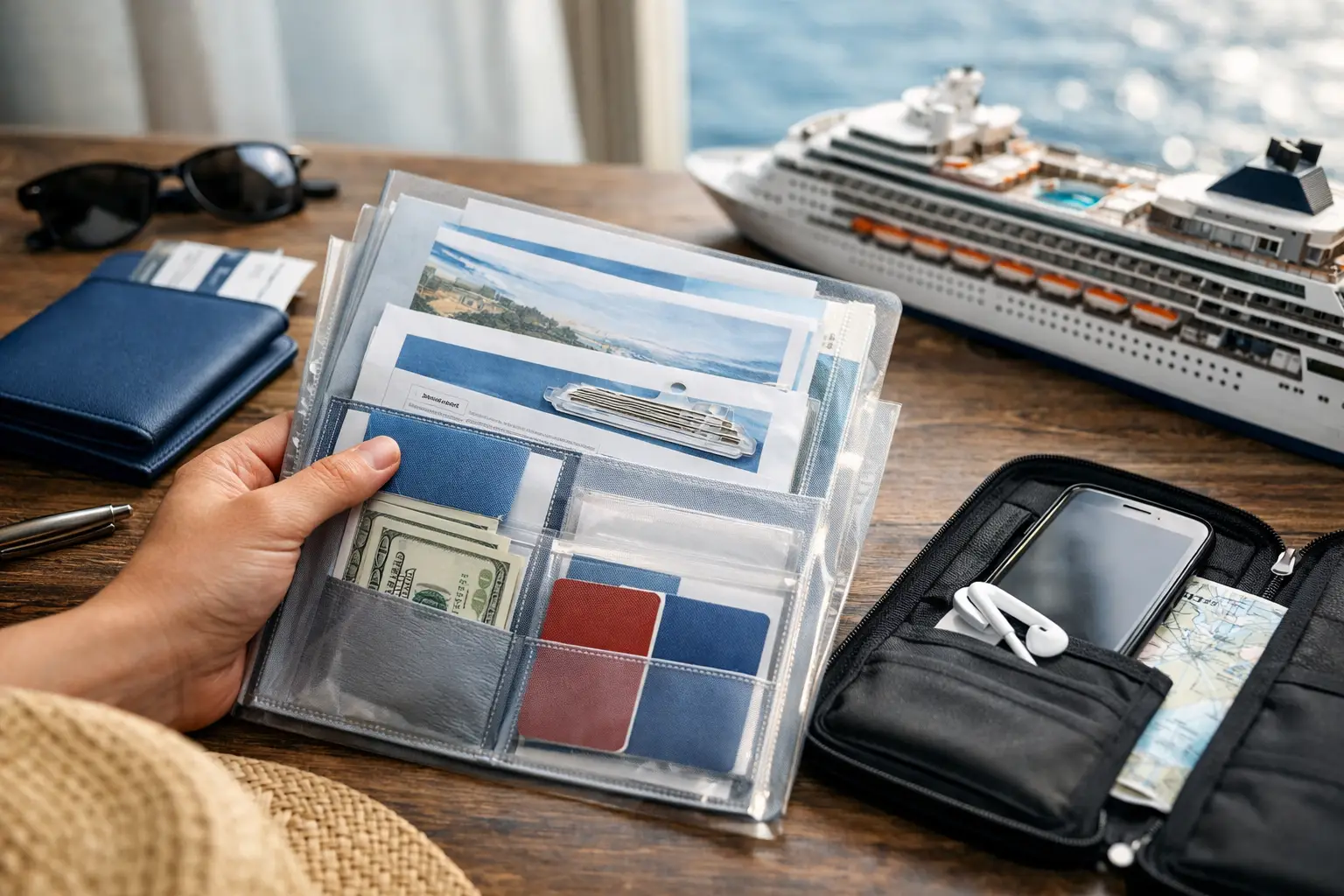
For most couples, one shared travel folder works well, provided each traveller knows where it is kept. Choose one with separate sections rather than a large pouch where papers can disappear behind one another. Arrange it in the order you will need things during the journey: outbound travel first, embarkation documents next, then insurance and itinerary information.
A simple divider system can make a real difference. Use sections for travel to the port, cruise paperwork, ports and excursions, and return travel. Place the documents for the first day at the front. If you have a pre-cruise hotel, put the hotel booking and transfer instructions directly behind your flight or train confirmation, not in a separate pile at home.
There is a balance to strike with printing. Printed copies are reassuring if a phone battery fails, an app will not load or a booking email is buried in your inbox. But printing every email creates unnecessary clutter. Print the documents that could be requested by a person at check-in, border control, a hotel desk or a transfer meeting point. Keep supplier terms, marketing emails and general packing information digitally unless you have a specific reason to carry them.
If you are travelling independently to the ship, print the terminal address, boarding time and cruise line emergency contact number. Port areas can be large, and taxi drivers or sat-nav systems do not always identify the correct cruise terminal from a ship name alone.
Create digital backups before you leave
Paper copies are useful, but they should not be your only system. Photograph or scan your passport photo page, travel insurance certificate, cruise confirmation, flight details and key transfer information. Save them in a secure folder on your phone and make sure they are available offline.
It is also sensible to keep a second copy somewhere separate. This could be in a secure cloud storage folder, on your travelling companion’s phone, or with a trusted family member at home. A photo of your passport will not replace the original at a border, but it can speed up the process of reporting a lost passport and confirming your details.
Before departure, download your cruise line app and sign in while you still have reliable home Wi-Fi. Some apps hold your daily programme, restaurant bookings, deck plans and shore excursion tickets. Screenshot important boarding details and transfer instructions as a backup. Onboard Wi-Fi may be chargeable, slow or unavailable in certain areas, so do not rely on being able to retrieve every document at the last minute.
Be cautious about security. Avoid sending passport images through casual group chats or leaving printed copies visible in an open cabin bag. Use a screen lock on your phone and, where possible, password protection for stored files.
Check what your itinerary actually requires
Cruise paperwork varies considerably by sailing. A round-trip cruise from Southampton can be relatively straightforward, while a fly-cruise with several countries on the itinerary may involve additional entry rules. River cruises can also include rail connections, airport transfers and hotel arrangements that need equal attention.
Read the cruise line’s pre-departure information carefully, particularly for countries where immigration checks take place during the cruise. Some destinations require visas, electronic travel authorisations, proof of onward travel or documentation for minors travelling without both parents. Requirements can change, so check official guidance close to departure as well as when you first book.
If you have booked shore excursions through an independent provider, keep their meeting point, local contact number and cancellation terms separate from cruise line excursions. Ship-organised tours are usually shown in the cruise app or daily programme, whereas independent arrangements may be confirmed only by email. Mixing the two can lead to a stressful morning in port.
The same applies to medical needs. Carry enough prescribed medication for the whole holiday, plus a little extra in case of disruption, in its original packaging in your hand luggage. A letter from your GP or pharmacy can be helpful for certain medicines or destinations, especially where you need to explain what you are carrying. Check whether your travel insurance provider needs to be told about existing medical conditions before you sail.
Give yourself a final document check
About a week before you travel, lay out everything in your folder and compare it against your full journey. Start at your front door and work forwards: travel to the airport or port, overnight hotel if applicable, embarkation, the cruise itself, ports of call, disembarkation and the journey home. This method reveals gaps that are easy to miss when documents are reviewed individually.
The evening before departure, put the travel folder, passports, phones, chargers, medication and a pen into your hand luggage. A pen remains useful for the occasional form, luggage label or customs declaration. If you are travelling as a couple, decide who carries the main folder and who holds the backup copies. There is no need for both people to carry every document, but both should know where the essentials are.
At the terminal, keep your passport and boarding pass in the same accessible pocket until you are on board. Once settled in your cabin, store passports and the main document folder in the cabin safe if it is large enough, or in a secure, discreet place in your luggage. Take only what you need ashore, such as a photocopy of your passport where suitable, cruise card and any required port documents. Whether you should carry your original passport ashore depends on the destination and the cruise line’s instructions.
A well-organised folder does more than prevent lost paperwork. It gives you room to enjoy the first sailaway, rather than wondering which email contains your transfer time. Prepare it once, keep it simple, and let the practical details stay quietly in the background of your holiday.
Frequently Asked Questions
Organising your cruise documents beforehand ensures a calm start to your holiday, avoiding stress at check-in. A cruise involves more elements than a typical hotel break, such as flights, hotel stays, and transfers, making proper preparation essential for a smooth journey from places like Southampton or the Mediterranean.
Your passport is the top priority; always check its expiry date well in advance. You’ll also need your cruise boarding passes, booking confirmation, luggage labels, flight, rail, hotel, and transfer confirmations, plus your travel insurance certificate and emergency contact number. Keep these core items in one clearly labelled travel wallet.
It’s best to strike a balance. Print documents that could be requested by a person at check-in, border control, or a hotel desk, such as boarding passes and key confirmations. Keep other information, like supplier terms or marketing emails, digitally. Always create digital backups of essential documents on your phone, accessible offline, and consider a second copy in secure cloud storage.
A shared travel folder with separate sections works well for most couples. Arrange documents in the order you’ll need them: outbound travel first, then embarkation papers, followed by insurance and itinerary details. Use dividers for categories like ‘travel to port,’ ‘cruise paperwork,’ and ‘return travel,’ placing first-day documents at the front.
Cruise paperwork varies, so carefully read your cruise line’s pre-departure information for visa or entry requirements, checking official guidance close to departure. For medication, carry enough for your trip plus extra, in original packaging, in your hand luggage, with a GP letter if needed. Keep independent shore excursion details separate from ship-organised tours.
About a week before travelling, lay out all documents and compare them against your entire journey, from leaving home to returning. This helps identify any missing items. The evening before, place your travel folder, passports, phones, chargers, medication, and a pen into your hand luggage, ensuring essentials are easily accessible.
Additional Resources

Additional Resources
The Essential Cruise & Travel Shop

Disclaimer
The Essential Cruise Shop Blog provides this guide for informational purposes and is not a travel agency. The information contained in this guide is for general guidance only. While we do our best to ensure the information is up-to-date and correct, we make no representations or warranties of any kind about its completeness or accuracy.
Cruise line policies, itineraries, and loyalty programs are subject to change without notice. We strongly recommend that you verify all details directly with your cruise line or a certified travel agent before making any bookings or financial commitments.
We cannot be held liable for any financial loss due to the reader’s failure to follow the above advice.
Affiliate Disclosure
Many of the links are affiliate links, The Essential Cruise Shop Blog may receive a commission from qualifying clicks, orders or bookings. This income helps support our efforts to provide and improve our site and turn it into a one stop resource for travellers with a bias towards cruising.