What Documents for Cruise Boarding? UK Guide
Introduction
The check-in desk is not the place to discover that a passport is in the wrong handbag, a visa has not been approved, or the name on a booking does not match the name on a travel document. Knowing what documents for cruise boarding are required before you leave home is one of the simplest ways to begin your holiday calmly.
For most UK cruisers, the essentials are straightforward: the correct passport, cruise boarding documents, and any destination-specific permissions. Yet the exact answer depends on your itinerary, nationality, whether you are flying to the ship, and the cruise line’s own requirements. A seven-night sailing from Southampton can involve a very different document check from a fly-cruise beginning in Barcelona, Athens or Miami.
What documents for cruise boarding do you need?
Start with your cruise line’s final travel documents. These are usually available in the online check-in area before departure and may be issued as a digital boarding pass, printable luggage tags and a booking confirmation. Complete online check-in as soon as the window opens, rather than leaving it until the evening before you travel. It gives you time to spot a passport number error, incomplete guest information or missing emergency contact details.
At the terminal, you will normally need your boarding pass and the travel document used during check-in. Cruise staff must verify that you can enter every country on the itinerary and, where relevant, return to the UK or continue to your next destination. A booking confirmation alone is not proof that you have the documents needed to sail.
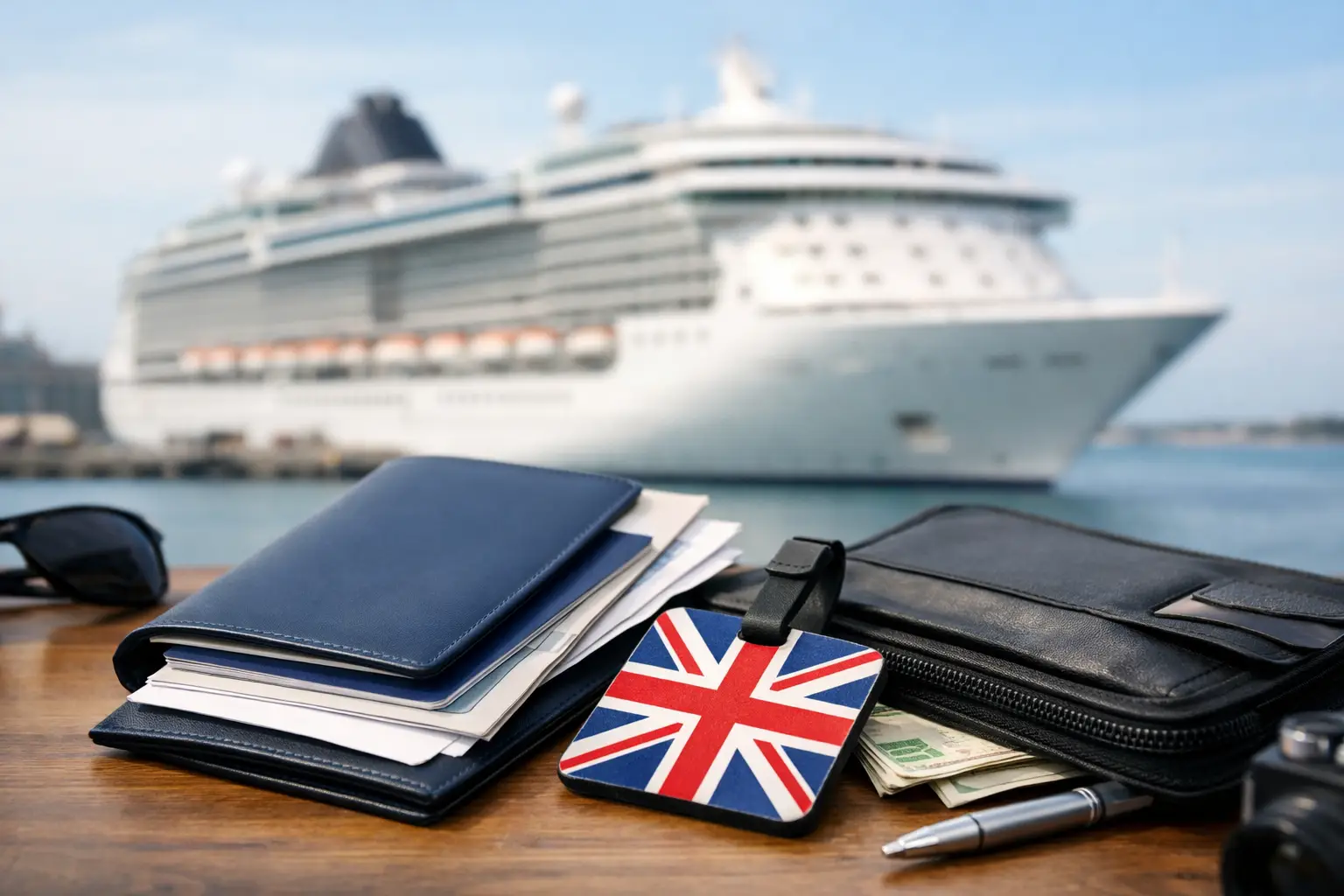
Your essential folder should contain your passport, boarding pass, cruise booking reference, travel insurance certificate and details of any visas, electronic travel authorisations or health declarations. If you are flying, keep airline tickets, hotel confirmations and transfer details with them. These are not always requested at the ship check-in desk, but they are invaluable when a delayed flight or missed transfer changes your plans.
Passport rules: check the itinerary, not just the embarkation port
A valid passport is the safest and most widely accepted document for a cruise holiday. Even on routes where another form of identification may sometimes be accepted, a passport makes unexpected itinerary changes far easier to manage.
Do not assume that a passport valid until the final day of the cruise will be enough. Some countries require a set period of validity beyond the date you leave, often three or six months, while others have rules about passport issue dates or spare blank pages. Airlines can apply these checks before they allow you to board a flight, so fly-cruise guests should review every country involved: the embarkation country, ports of call, transit airports and disembarkation country.
For UK passport holders travelling within parts of Europe, passport validity rules can be more complicated than they first appear. Your passport will need to have been issued within 10 years before arrival and remain valid for a period after departure. The cruise line’s guidance is useful, but official destination advice should always be your final check, particularly if you hold a non-UK passport or have residency in another country.
A driving licence is not a substitute for a passport on an international cruise. It can be useful as extra photo identification for land arrangements, but it will not solve a passport problem at the port.
Cruises from the UK still need careful checks
Sailing from Southampton, Dover or another UK port can feel simpler because there is no flight to organise. That does not mean document requirements disappear. Your ship may call at EU countries, Norway, Iceland, the Channel Islands, the Caribbean or further afield, and the relevant entry conditions still apply.
Some short cruises may have specific identification options for British citizens, but these arrangements can change and may not suit every itinerary or guest. If you are taking a cruise that visits an overseas port, travelling with a passport is usually the most practical choice.
Visas, electronic authorisations and destination forms
A visa is not required for every cruise port, but the responsibility for holding one rests with the traveller. Cruise lines may refuse boarding if you cannot show the required permission, even if you planned to stay on board in that country. Immigration rules are based on the ship’s itinerary and your nationality, not your intention to go ashore.
Electronic travel authorisations deserve the same attention as traditional visas. Depending on your route, you may need an approved online authorisation for a country you fly through, begin your cruise in or visit during the voyage. Approval can be quick, but it is not always instant. Apply early enough to deal with errors, additional questions or a declined application.
Print or save evidence of approval where possible. A border system may be able to see it electronically, but a saved confirmation makes a stressful conversation much easier. Keep the name, passport number and dates on every authorisation exactly aligned with your passport and cruise booking.
Certain ports also use pre-arrival forms, customs declarations or health questionnaires. Your cruise line may collect these through its app or online account. Read each question carefully, especially those covering medication, recent travel or contact details. A rushed answer can create avoidable delays at check-in.
Documents for children, families and different surnames
Children need their own passport and any visas or authorisations required for the itinerary. A child cannot travel internationally on a parent’s passport, and a birth certificate is not a replacement for a passport at cruise boarding.
If a child is travelling with one parent, grandparents or another adult, carry any consent documentation requested by the cruise line or relevant authorities. Requirements vary by country and family circumstances, so check well before travel. A consent letter may need specific wording, supporting identification or formal witnessing.
Adults travelling under a different surname from the name on their passport should ensure the booking is made in the passport name. If you have recently married, divorced or changed your name, bring the relevant supporting certificate if there is any possibility of a question. The same applies where a child’s surname differs from that of the accompanying adult.
Health, insurance and medication paperwork
Health requirements change more often than passport rules. Your cruise line will tell you if it requires a vaccination record, health declaration, testing evidence or other medical paperwork. Do not rely on a screenshot from a previous holiday, as each sailing can have different conditions.
Travel insurance is not always inspected at boarding, but it should be treated as a core cruise document. Check that it covers cruising, overseas medical treatment, cancellation, missed departure and evacuation where appropriate. A policy designed for a UK break may not provide the protection needed for a Mediterranean fly-cruise or a long-haul voyage.
Take prescription medication in its original labelled packaging and carry a copy of your prescription or a letter from your clinician for controlled medicines, injectable medication or larger quantities. Keep medication in your hand luggage, never in checked bags handed over at the terminal. If a bag arrives late to your cabin, you should still have what you need.
Digital copies are useful, but do not rely on them alone
Cruise apps and digital boarding passes are convenient, particularly when you are managing flights, transfers and hotel stays around the sailing. Download key documents before leaving home and save them somewhere accessible without mobile data. Port terminals and overseas airports are not the ideal places to depend on a weak signal or a forgotten password.
However, a phone is not a complete document strategy. Batteries go flat, screens break and devices can be misplaced. Carry printed copies of your boarding pass, insurance certificate, itinerary and visa approvals in a slim travel wallet. Keep the originals of passports and official permissions secure and separate from spare copies.
It is also sensible to leave copies of passports, travel insurance and your itinerary with someone you trust at home. This will not replace a lost passport, but it can speed up the process of reporting a loss and obtaining support.
A final check before you set off
Two weeks before departure, compare your passport, cruise booking, flights, visas and insurance documents line by line. Check names, dates, passport numbers and port timings. Then repeat the check when you pack your hand luggage, placing the documents somewhere you can reach without opening your suitcase.
A well-organised document wallet will not make the terminal queues vanish, but it does mean you can approach the desk knowing that the small, crucial details are already taken care of. That is a far better way to begin a cruise holiday.
Frequently Asked Questions
Additional Resources

The Essential Cruise & Travel Shop

Disclaimer
The Essential Cruise Shop Blog provides this guide for informational purposes and is not a travel agency. The information contained in this guide is for general guidance only. While we do our best to ensure the information is up-to-date and correct, we make no representations or warranties of any kind about its completeness or accuracy.
Cruise line policies, itineraries, and loyalty programs are subject to change without notice. We strongly recommend that you verify all details directly with your cruise line or a certified travel agent before making any bookings or financial commitments.
We cannot be held liable for any financial loss due to the reader’s failure to follow the above advice.
Affiliate Disclosure
Many of the links are affiliate links, The Essential Cruise Shop Blog may receive a commission from qualifying clicks, orders or bookings. This income helps support our efforts to provide and improve our site and turn it into a one stop resource for travellers with a bias towards cruising.